
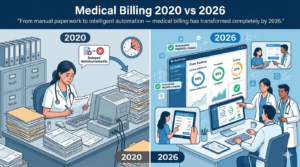
Medical billing used to be the department nobody outside of finance thought much about. Claims went in, payments came back — or didn’t — and the cycle repeated. In 2026, that picture has changed beyond recognition.
In 2026, the medical billing industry is dominated by AI-driven automation, proactive denial management, and hyper-personalized patient financial experiences. Key trends include the rise of “Zero-Day Denials” — where claims are corrected and resubmitted within 24 hours — a decisive shift to value-based care reimbursement models, and extensive 2026 CPT coding updates requiring rapid staff adaptation, including 288 new codes alone. Revenue cycle management (RCM) is now a core, tech-driven financial pillar — not a back-office afterthought.
The numbers reflect just how seriously the industry has taken this transformation. The global medical billing outsourcing market is projected to grow from $20.31 billion in 2026 to $50.47 billion by 2034, at a CAGR of 12.05%. For providers, specialists, and healthcare administrators, understanding what is driving this growth is not optional — it is essential to staying financially sustainable in an increasingly demanding environment.
This guide breaks down the seven defining trends reshaping medical billing in 2026, what each one means practically for your practice, and how to position your organization to benefit rather than fall behind.
The State of Medical Billing in 2026: A Snapshot
Before diving into individual trends, it helps to understand the landscape these trends are emerging from.
Medical billing errors remain a staggering industry problem. About four in five medical bills contain some form of error — a statistic that has fuelled the push for automation and AI-powered accuracy tools. At the same time, approximately 100 million Americans carry a combined $220 billion in medical debt, signalling that the financial burden of healthcare is now a patient experience crisis, not just a billing department problem.
These pressures — accuracy failures, compliance complexity, rising patient financial responsibility, and workforce shortages — are the engine behind every major trend reshaping the industry in 2026. They are not isolated problems. They are interconnected, and the solutions emerging to address them are equally interconnected.
Healthcare billing trends in 2026 emphasise speed, accuracy, and transparency. Providers now recognise that efficient billing is critical to maintaining cash flow and reducing revenue leakage. As a result, investments in technology and skilled professionals are increasing across healthcare organisations of all sizes.
Trend #1: AI and Autonomous Coding Are Now the Standard
If 2024 was the year AI entered the billing conversation, 2026 is the year it took over the room.
From Automation to Autonomy
Artificial Intelligence has transitioned from automation to autonomy, with AI-driven coding and claims processing now standard practice across billing departments seeking to increase accuracy and speed. Natural Language Processing (NLP) is deeply integrated into these systems, enabling them to analyse clinical documentation and extract billing-relevant data without human intervention.
AI-powered tools are now standard equipment in billing departments across the country. These systems can review claims before submission, catching errors that would typically result in denials — and they do it faster and more consistently than any human team can manage at scale.
What AI Is Doing in Billing Departments Right Now
The practical applications are wide-ranging. Advanced integrations of AI in medical billing support eligibility checks and claim scrubbing. By spotting errors pre-submission and predicting denials before a claim is even sent, these scrubbing tools help improve reimbursement outcomes significantly. Automated medical billing solutions now handle routine payment posting, replacing repetitive manual tasks with smarter, faster processing.
Machine learning algorithms continuously improve billing accuracy by learning from historical claim data — reducing rework, flagging anomalies, and boosting first-pass claim rates over time.
Robotic Process Automation (RPA) Fills the Gaps
Running alongside AI is Robotic Process Automation (RPA), which is taking on an expanding role in revenue cycle operations. These software tools perform rules-based tasks that previously required human staff — from posting payments to following up on unpaid claims. The benefit of automation is speed and consistency: automated processes do not make typos, forget steps, or handle the same situation differently depending on the day.
Together, AI and RPA are transforming medical billing from a labour-intensive function into a lean, technology-driven operation — and practices that have not yet adopted these tools are already feeling the competitive disadvantage.
Trend #2: Proactive Denial Management and Zero-Day Denials
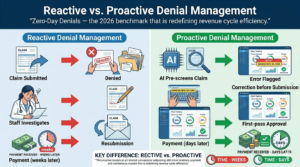
The old approach to claim denials was reactive: a claim gets denied, a staff member investigates, a correction is made, the claim is resubmitted. The entire process could take weeks. In 2026, that model is being replaced entirely.
Moving from Reactive to Proactive
The industry is moving from reactive fixing to proactive prevention. AI identifies missing charges and potential denials pre-submission, aiming for what has become the industry’s most sought-after benchmark: “Zero-Day Denials” — where claims are corrected and resubmitted within 24 hours of any rejection flag being raised.
This shift represents a fundamentally different mindset. Rather than treating denials as an inevitable part of the revenue cycle, leading billing organisations are treating them as preventable system failures. Predictive denial management tools analyse claim data against payer rules in real time, flagging issues before submission rather than after rejection.
Why It Matters for Revenue
Denial management is not just an administrative concern — it is a direct revenue issue. Practices that move to proactive prevention models are recovering revenue faster, reducing administrative workload, and improving their overall collection rates. The practices still relying on traditional reactive workflows are leaving significant money on the table.
For billing departments in 2026, the question is no longer whether to adopt proactive denial management — it is how quickly they can implement it.
Trend #3: The Shift from Fee-for-Service to Value-Based Care Billing
Perhaps no single change is reshaping medical billing more profoundly than the accelerating move away from fee-for-service reimbursement.
How Reimbursement Is Being Redefined
Value-based care models, bundled payments, and specialised billing solutions are replacing traditional fee-for-service, rewarding providers for patient outcomes rather than service volume. By 2026, this shift toward value-based reimbursement has accelerated, forcing providers and billing companies alike to fundamentally rethink their metrics.
Instead of submitting a claim for each individual service rendered, billing under value-based models requires tracking outcomes, documenting quality measures, and integrating clinical data with financial reporting. RCM processes must now capture quality metrics, readmission rates, and preventive care data — a far more complex picture than simple procedural billing.
Bundled Payments and Their Billing Implications
Bundled payments for episodes of care represent another growing element of this shift. Rather than billing separately for each service during a treatment episode, providers receive a single payment covering all related care. This requires careful tracking of all services provided, coordination among multiple providers, and often internal reconciliation to distribute payment appropriately among participants.
The billing implications extend to denial management as well. When quality metrics are not met, payments may be reduced or withheld — and appealing these outcomes requires clinical documentation demonstrating quality standards were achieved, which differs significantly from traditional claim appeals focused on coding accuracy.
Billing specialists in 2026 must collaborate closely with clinical teams. The wall between clinical documentation and billing operations has effectively been dismantled, and practices that have not adapted to this integrated model are finding their revenue increasingly at risk.
Trend #4: The 2026 CPT Coding Updates — A Major Adjustment Year
Every year brings coding changes, but 2026 stands out as a particularly significant update cycle.
What Changed in the 2026 CPT Code Set
The 2026 CPT code set includes substantial changes that billing departments have had to absorb rapidly: 288 new codes, 46 revisions, and 84 deletions — forcing staff to update systems, retrain teams, and audit existing workflows. Any practice that has not systematically reviewed its coding processes against these updates risks submitting claims with outdated or incorrect codes, directly triggering denials and compliance flags.
The new codes reflect the continued expansion of telehealth services, new diagnostic and therapeutic procedures, and the coding infrastructure required to support value-based care quality reporting. For billing teams, staying current is not just about accuracy — it is about compliance, and in 2026, regulatory oversight is more intense than ever.
Payers now use their own automated tools to audit claims. Clinical documentation must be in perfect alignment with billing at all times, because even small errors can trigger a full audit. Compliance teams must work closely with billing staff, and regular training on coding updates is no longer optional — it is the baseline requirement for avoiding heavy penalties.
Trend #5: Enhanced Patient Financial Experience and Price Transparency
Patients are increasingly arriving at billing conversations with the same expectations they bring to online shopping — and providers who fail to meet those expectations are seeing the consequences in patient satisfaction scores and collection rates.
Patients Now Expect Billing Clarity
With increasing high-deductible health plans, billing systems now offer hyper-personalised, transparent digital payment solutions that allow patients to understand their financial responsibility before, during, and after care. Patients want the smooth user experience they have with e-commerce: electronic statements that clearly state the cost divisions, no surprise bills, and no confusing codes — just valued care that builds trust.
Federal price transparency rules that began in previous years continue to expand in scope and enforcement in 2026. Patients now have access to information about what services cost before they receive care. They can compare prices between providers and make decisions based on cost — a dynamic that would have seemed unlikely just five years ago.
Digital-First Payment Is Non-Negotiable
Online payment portals, text-to-pay options, and automated payment plans remove friction from the collection process. Practices that make payment difficult will see their patient collection rates suffer. Those that invest in seamless digital payment infrastructure are not just improving collections — they are building the kind of patient trust that translates to long-term retention.
Billing is now, fundamentally, a patient experience function. The practices winning in 2026 are the ones that have accepted this and built their financial operations accordingly.
Trend #6: Telehealth Billing Becomes Permanent Infrastructure
Telehealth is no longer a pandemic-era workaround. In 2026, virtual care billing has stabilised into permanent payer policy, and the billing complexity it brings has only grown.
A High-Risk Billing Environment
Different payers have different rules for telehealth reimbursement. Some require specific modifiers; others have restrictions on which services can be delivered virtually. Keeping track of these variations requires dedicated attention from billing staff — and mistakes in telehealth billing are common and frequently result in denials or reduced reimbursement.
As telehealth volume remains high across specialties, billing teams cannot afford to treat virtual visit billing as a secondary concern. It requires the same level of payer-specific knowledge and coding precision as any in-person service — and in many cases, more, given the ongoing variability in coverage rules.
Healthcare organisations are increasingly outsourcing to specialised firms to handle complex AI-driven prior authorisations and regulatory compliance updates around telehealth — recognising that in-house teams may lack the bandwidth and specialised expertise to manage it accurately at scale.
Trend #7: Medical Billing Outsourcing and System Integration Hit New Heights
Two parallel forces are reshaping the operational structure of billing in 2026: the growth of outsourcing as a strategic decision, and the integration of RCM systems into a single unified data ecosystem.
Why Outsourcing Has Become Strategic
The U.S. is projected to face a labour shortage of around 3.2 million people for healthcare billing services — a gap that no amount of internal recruitment alone can fill. This, combined with the complexity of managing AI-driven billing tools, evolving compliance requirements, and payer rule changes, has pushed healthcare organisations toward specialist billing partners at an accelerating pace.
Outsourcing is no longer seen as cost-cutting — it is a strategic partnership to enhance operational agility and revenue outcomes. The front-end segment, covering patient scheduling, insurance eligibility verification, and pre-authorisation, has captured the highest share of outsourced billing demand, reflecting where the greatest accuracy pressures exist at the start of the revenue cycle.
The Rise of Unified RCM Platforms
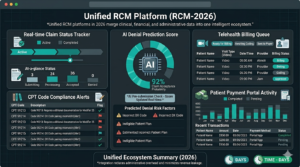
RCM, electronic health records (EHR), and practice management software are increasingly integrated in 2026, allowing for real-time analytics to monitor financial performance at every stage of the billing cycle. Practices that previously juggled multiple disconnected systems — billing software, clearinghouses, EHR platforms — are moving toward unified data platforms that merge clinical, financial, and administrative data into a single ecosystem.
This interoperability enables faster decision-making, earlier identification of revenue leakage, and a much clearer view of overall financial performance. It is, in many ways, the infrastructure that makes every other trend on this list possible.
How to Prepare Your Practice for These Trends
Understanding these trends is step one. Acting on them is where competitive advantage is built. Here is where to focus your attention:
Audit your automation gaps. Identify which parts of your billing workflow still rely on manual processes and prioritise those for automation or AI tool integration first.
Invest in coding education. The 2026 CPT updates are not a one-time adjustment — they signal an ongoing pace of change that requires structured, continuous staff training. Build this into your operational calendar.
Evaluate your outsourcing strategy. If your team is stretched thin managing complex payer rules, prior authorisations, and compliance requirements, a specialist billing partner may deliver more value than an expanded in-house team.
Redesign the patient billing experience. Audit your current patient communication from the first cost estimate to the final payment confirmation. If any part of it involves paper statements, unclear language, or manual follow-up, it needs updating.
Unify your systems. If your EHR, billing software, and practice management platform are not communicating in real time, closing that integration gap should be a 2026 priority — not a future consideration.
Frequently Asked Questions
What are the biggest medical billing trends in 2026?
The leading trends include AI and autonomous coding, Zero-Day Denial management, the shift to value-based care billing, the 2026 CPT code updates (288 new codes), patient-centric digital payment experiences, telehealth billing permanence, and outsourcing as strategic RCM partnership.
How is AI changing medical billing in 2026?
AI has moved from supporting billing staff to largely directing the process — handling eligibility verification, claim scrubbing, denial prediction, and payment posting with greater speed and accuracy than manual teams can achieve.
What are Zero-Day Denials?
Zero-Day Denials is the emerging industry benchmark where any flagged or denied claim is corrected and resubmitted within 24 hours, replacing the traditional multi-week reactive denial management cycle.
Is medical billing outsourcing worth it in 2026?
For most mid-to-large practices, yes. With a projected labour shortage of 3.2 million billing professionals and growing regulatory complexity, outsourcing to specialist vendors provides both the expertise and technology infrastructure that internal teams often cannot maintain alone.
What are the 2026 CPT code changes?
The 2026 CPT code update includes 288 new codes, 46 revisions, and 84 deletions — the most significant annual update in recent years, requiring prompt system updates and staff retraining.
How does value-based care affect billing operations?
It fundamentally changes the data billing teams must capture and report. Instead of submitting claims for individual services, value-based billing requires tracking outcomes, quality metrics, readmission rates, and episode-based bundled payments — demanding much closer collaboration between clinical and billing teams.
Final Verdict: 2026 Is the Year Medical Billing Becomes Fully Strategic
The medical billing industry in 2026 is not simply adopting new tools — it is undergoing a structural transformation in how billing is understood, staffed, and executed within healthcare organisations.
AI and automation have moved from optional enhancements to operational necessities. Value-based care has made billing a clinical-financial collaboration. Price transparency and digital payment expectations have made billing a patient experience function. And the scale of the 2026 CPT code updates has made ongoing compliance education a non-negotiable investment.
Organisations that adapt to these changes will find real opportunities for improved efficiency, stronger revenue performance, and better patient relationships. Those that remain static risk not just falling behind financially — but becoming structurally unable to meet the expectations of payers, regulators, and patients alike.
Staying ahead in this environment requires ongoing education, smart technology investment, and — for many organisations — partnerships with specialists who bring both the expertise and the infrastructure to manage an increasingly complex billing landscape.
Ready to future-proof your billing operations? Connect with an experienced RCM specialist today and ensure your practice is positioned to thrive in 2026 and beyond. Contact Us Today.